CoSMoS
Conservation and Sustainable Use of Mountains and Mountain Ranges (CoSMoS, acronym in Spanish) aims to improve the conservation status and sustainable use of ecosystems in central Mexico.
The Project
The objective of the Conservation and Sustainable Use of Mountains and Mountain Ranges (CoSMoS, Spanish acronym) project is to improve the state of conservation and sustainable use of the ecosystems of central Mexico.
Context
Within the framework of Mexico-Germany cooperation, both countries agreed to the joint development of CoSMoS. The project was born with the idea of carrying out conservation, restoration, and sustainable use actions on the route that Alexander von Humboldt, the German scientist, followed on his five-year trip through Latin America. In 1803, Humboldt arrived in Mexico, disembarking in the port of Acapulco to settle in Mexico City, from where he left for different destinations in the mountains of the Neovolcanic Axis and the Altiplano, setting sail from the port of Veracruz.
CoSMoS embodies the current vision of the Government of Mexico to strengthen the sustainable management of the territory, improve the effective management of its protected areas (PAs) and areas of influence, and strengthen the communities that inhabit them, facing new global challenges, such as the recent COVID-19 pandemic and the effects of climate change.
The lines of work that guide CoSMoS’ actions are:
- Strengthen the effective management of federal PAs.
- Support the restoration of ecosystems.
- Promote the sustainable use and exploitation of ecosystem goods and services provided by federal PAs (strengthen the local economy).
- Contribute to developing digital infrastructure and applied technology to improve decision-making, effective communication, and environmental education regarding biodiversity conservation.
CoSMoS will promote the conservation and sustainable use of the mountain ecosystems of central Mexico.
Achievements
In 2023, Mexican Fund for the Conservation of Nature (FMCN) established the project coordination unit and developed the plan that will guide all CoSMoS actions over five years. As part of this phase, a social and environmental assessment was conducted to identify potential risks associated with the proposed activities and to establish effective mitigation measures.
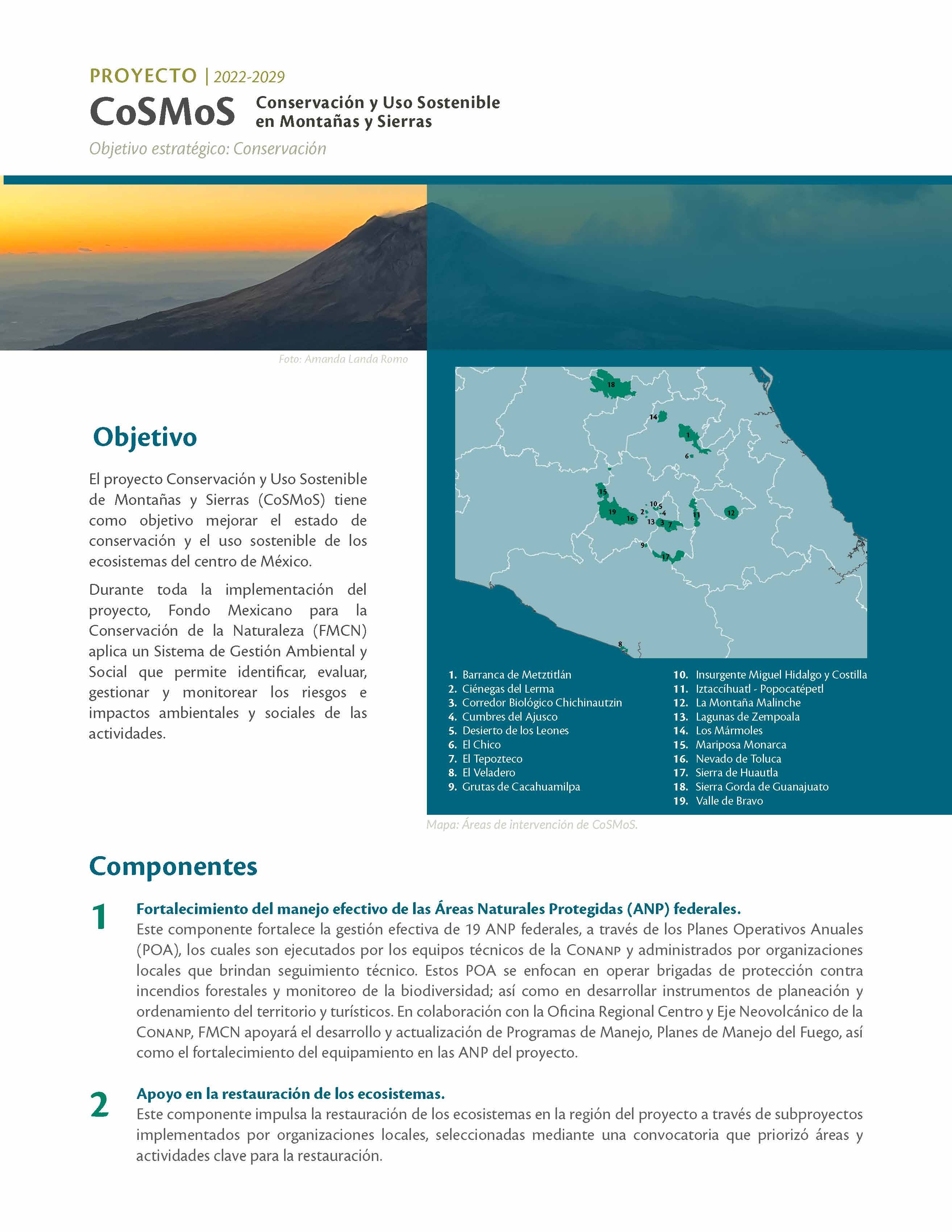
In parallel, FMCN and the National Commission of Natural Protected Areas (Conanp, acronym in Spanish) collaborated on five-year strategic planning for the 19 Protected Areas (PAs) supported by CoSMoS. This included the development of Annual Operational Plans (POAs, acronym in Spanish) and the identification of environmental and social safeguards.
An alliance was also established with the National Commission for the Knowledge and Use of Biodiversity (Conabio, acronym in Spanish), which will design and implement a monitoring system to assess the conservation status and threats to ecosystems within the CoSMoS project area.
FMCN strengthened the management of the 19 PAs under the CoSMoS project through the implementation of the 2025 Annual Operational Plans (POAs, acronym in Spanish), in close coordination with Conanp and local organizations. During the first half of the project’s implementation, the PAs advanced in consolidating fire management and biological monitoring brigades, as well as acquiring specialized equipment to enhance their operational capacity. Likewise, five of them rehabilitated their infrastructure and community nurseries.
In terms of ecosystem restoration, nine initiatives began actions focused on reforestation, fire management, and riparian restoration, promoting the recovery of strategic habitats.
To strengthen local economies, the project supported 111 community-based enterprises through six Local Technical Assistance Providers, who conducted participatory diagnostics and capacity-building workshops.
In support of decision-making processes, Conabio defined the areas of influence of the PAs and calculated habitat transformation rates. In addition, it is advancing in the design of a monitoring system and a digital platform that will facilitate decision-making and environmental education.
Allies
Donor: KfW Development Bank
Partners:
- National Commission of Natural Protected Areas (Conanp, acronym in Spanish)
- National Commission for the Use and Knowledge of Biodiversity (Conabio, acronym in Spanish)
Contact
To address any questions, clarifications, suggestions, complaints, or comments related to CoSMoS, we provide you with the following means of contact corresponding to the project's Complaints and Inquiries Mechanism. Your request will be treated with confidentiality, responsibility, and interest by the representatives of the project.
E-mail: denuncia@fmcn.org
Postal address: Francisco Sosa 102. Santa Catarina. Delegación Coyoacan. CDMX. C.P. 04010.
Telephone: 55 5611 9779